
Policy has moved from whether to use AI in teaching to how. Here is what modern academies do differently to prepare graduates for real work.
That shift reframes the leadership question. The work is less about which tools to buy and more about design. What habits do we want learners to build? How do we help new graduates cope in their first months of real work?
From our work with academies, training centres and vocational colleges, three patterns keep proving themselves:
Teach with AI in the open.
Assess applied judgement.
Operate early careers with reliable AI support.
Learn with AI in the open
Students already use AI to plan, practise and check understanding. The helpful move is structured visibility: invite responsible use and ask for light documentation so you can see their thinking. Nothing demonstrates learning better than a learner explaining it in their own words.
What we have seen work is simple. Pair AI with a plan, retrieve, reflect loop. Let AI help produce practice items and varied scenarios, then have the learner show what changed in their understanding. You might add a short AI use note to each assignment, covering the prompts they used, the key change in their understanding, what remains uncertain and the sources they consulted.
These notes give you something to grade and a better basis for conversations between learners and tutors.
Assess for applied judgement
If AI can complete the task convincingly, it may be the wrong task. If students are going to use AI in assessment either way, it is better to measure how they use it than to try to catch them out.
A pattern you can adopt without overhauling everything:
Variant scenario. Rotate constraints so success requires adaptation rather than memory.
Micro-viva. A quick 3 to 5 minute oral check that asks for one decision in the learner's own words.
Evidence log. Show the sources used, how they were weighed and what changed during the work.
These are light, easy to pilot and strong enough to change behaviour. You will hear the trade-offs a learner made and the risks they saw. You will also see where AI was used well, which is fine. It is part of the world your graduates are entering.
Turn skill into income after certification
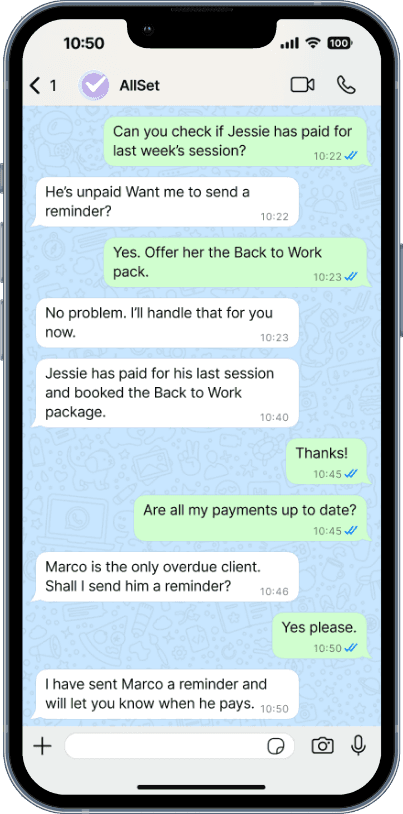
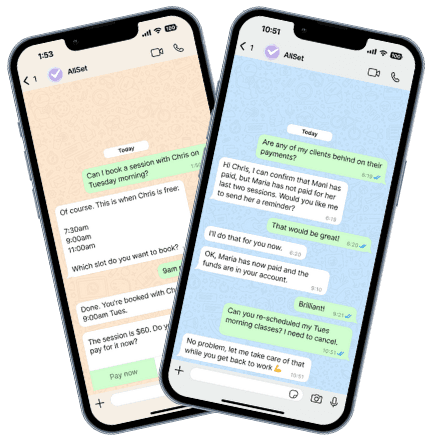
Learning does not stop at graduation. That is the moment graduates enter a market that already runs on AI. The edge after certification comes less from another booking app or payments portal, and more from conversational AI as the layer where graduates win work and get paid.
Early careers tend to fail quietly in admin: missed confirmations, loose reschedules, slow payment, no recovery when a client cancels. Clients live in messages, so friction anywhere else costs momentum. And if a graduate cannot show how their operations are going, they have little to point to.
When AI runs that operational layer, a few things change for a new graduate:
Bookings get confirmed, risk gets managed and payment gets taken in real time, rather than just reminded about.
Capacity gets used. AI helps balance a diary so quiet slots get filled.
Work happens in the channels clients already use, so the tool actually gets used.
It produces real signals instead of anecdotes: session completion, recovery of late cancellations, payment speed, and utilisation at 30, 60 and 90 days.
This is why we suggest teaching conversational AI inside business operations modules. When a new personal trainer can offer slots, confirm, backfill a late cancellation and take a deposit in chat, they build momentum early, before bad habits set in. When a graduate stylist fills weekday gaps with timed offers that match slot length and processing windows, deposits become normal and rebooking becomes routine.
Treat operations as part of the curriculum, and a graduate's early momentum stops being a matter of luck.
Checklist: What to consider this term
If you want a place to start, here are three light moves that make progress without creating a programme you cannot carry.
Publish AI usage norms for learning. Share examples of strong AI notes and add reflection prompts to a few core modules.
Redesign one high-stakes assessment. Apply the variant scenario, micro-viva and evidence log pattern, and tune the rubric toward judgement over presentation.
Talk to us about a 90-day conversational AI programme for new graduates. We deploy a bespoke AI agent into the chat where graduates already organise their business and clients.
A post-cert edge for colleges and students
Academies and vocational colleges that work this way tend to do better on learner experience and employer trust. They can publish cohort outcomes with confidence, and they attract stronger applicants and partners. They get there by designing the experience around the world their graduates actually enter.